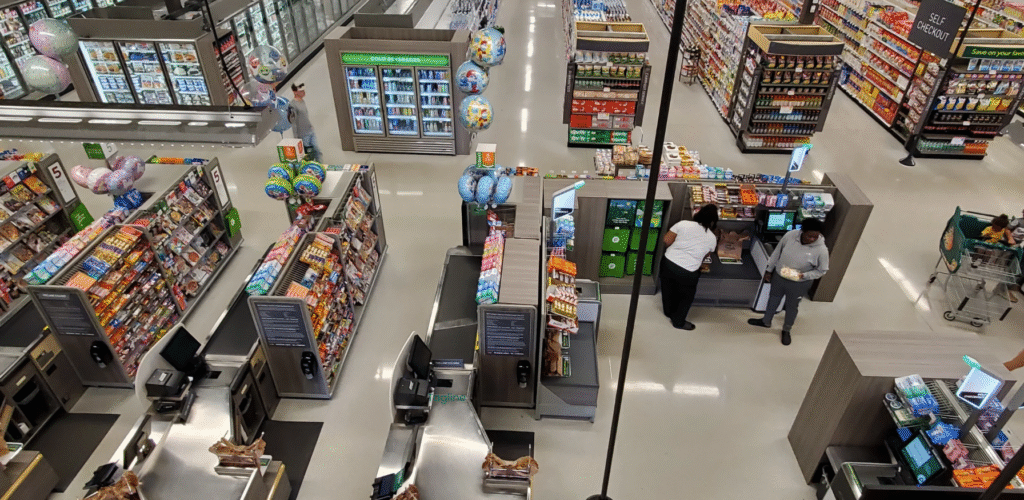
Walk through any major city in Nigeria today and the supermarket is everywhere. A decade ago, the landscape was simpler — Shoprite dominated, a few local names held their corners, and most Nigerians still relied on open markets for their weekly shopping. Fast forward to 2026, and Nigeria now has well over 5,000 registered supermarkets, with dozens of chains battling for the loyalty of an increasingly savvy consumer.
The economic pressures of recent years — inflation, naira depreciation, rising food costs — have not slowed the growth of organised retail. If anything, they have accelerated it. Nigerians are looking for places where they can stretch every naira further, trust the quality of what they buy, and shop without the stress of market haggling. The supermarket, in all its forms, is answering that call.
This guide covers the 10 supermarket chains that matter most right now — ranked by reach, brand strength, and overall impact on how Nigeria shops. Whether you are a consumer looking for the best place to spend your money, or someone studying the business of retail, these are the names you need to know.
#1 Bokku! Mart
Nigeria’s Fastest-Growing Retail Phenomenon
Founded: September 30, 2022
Stores: 124+ (primarily Lagos, expanding nationally)
Owned by: Atreos Limited
Model: Hard discount — affordable essentials in neighbourhood format
If you have not heard of Bokku! Mart, you clearly have not been to Lagos recently. In just over two years since its first store opened on September 30, 2022, Bokku has done something no other Nigerian retailer has managed: it has become the most widespread grocery chain in the country, with over 124 outlets and counting.
The concept is brilliantly simple. Instead of building massive destination malls that require a car to visit and a substantial budget to shop in, Bokku went the other way entirely. Small stores — roughly 200 to 250 square metres each — tucked directly into the neighbourhoods where people already live. The goal is radical proximity: you should never be more than two kilometres from a Bokku outlet. In Lagos, that goal is increasingly being achieved.
The business model is inspired by Germany’s hard discount giants, Aldi and Lidl. A tight range of around 350 essential grocery products. Prices that undercut the competition. No frills, no theatrics — just value. The results have been extraordinary. Queues regularly form at Bokku’s in-store bakery, where a 900g loaf of bread sold for ₦950 at a time when competitors charged ₦1,300 to ₦1,600 for the equivalent. Customers who had to walk past older, more established brands chose Bokku for that price difference alone.
What makes Bokku’s rise even more remarkable is the timing. It launched during one of the most difficult economic periods in Nigeria’s recent history. Inflation was biting hard. Household purchasing power was shrinking. And into that environment walked a supermarket chain that said: we will meet you where you are, at prices you can actually afford. Nigerians responded enthusiastically.
The ownership story is still partly shrouded in mystery — different reports name different individuals as founder — but the parent company, Atreos Limited, had been signalling this direction for years. As far back as 2017, Atreos’s leadership was publicly arguing that the future of Nigerian retail was neighbourhood formats, not giant malls. Bokku is the execution of that thesis at speed.
Whether Bokku can maintain this pace and quality as it scales further remains the key question. But right now, it sits at the top of this list by every measure of reach and momentum.
#2 Addide Supermarket
Lagos’s Neighbourhood Institution
Founded: 2008
Stores: 44 (predominantly Lagos)
Model: Proximity-based convenience, everyday essentials
Before Bokku came along and rewrote the rulebook, Addide was the chain that understood something most Nigerian supermarkets had missed: the best store is the one closest to you.
Founded in 2008 and headquartered in Lagos, Addide built its 44-store network by going into the neighbourhoods that larger chains ignored — Akoka, Bariga, Gbagada, Ijesha, Surulere, Ipaja, Ketu, Ogba, Ojodu, Okota, Aguda. These are not the glamorous postcodes. These are where millions of Lagosians actually live. And that is precisely why Addide found an audience there.
The stores are smaller than what you would call a conventional supermarket — most are under 100 square metres — and the range is focused on the everyday: groceries, household items, drinks, personal care products. You will not find a full fresh produce section or an in-store restaurant. What you will find is everything you need to restock your kitchen, available without a long journey and without premium pricing.
Addide’s investment in technology has also set it apart from many local competitors. The checkout experience is efficient, and the brand has worked to ensure consistent product availability across its locations. It may not be the most glamorous name on this list, but for everyday Lagos shopping, Addide remains a reliable, trusted choice with more than 15 years of street credibility.
#3 Market Square
The South-South Champion
Founded: 2015
Parent Company: Sundry Markets Limited
Stores: 36
Key regions: Rivers, Akwa Ibom, Abia, Imo, and South-East
While much of Nigeria’s retail conversation focuses on Lagos and Abuja, Market Square has been quietly building something impressive in the South-South and South-East of the country — regions that major chains historically underserved.
Founded in 2015 by Sundry Markets Limited, Market Square now operates 36 stores with a particularly strong grip on Rivers, Akwa Ibom, Abia, and Imo states. Port Harcourt, in particular, has seen Market Square become a genuine retail anchor. The chain offers what you would expect from a well-run modern supermarket: fresh produce, groceries, household essentials, baked goods, and electronics, all under one roof.
What Market Square has built is regional loyalty — the kind that comes from being present and consistent in a market that others took years to enter, or never entered at all. Shoppers in Port Harcourt have grown up with Market Square as their reference point for modern retail, in the same way that Lagos consumers might default to a more nationally recognisable name.
The chain’s model is modern without being ostentatious, and its expansion within its core regions continues steadily. For any understanding of Nigerian retail that goes beyond Lagos-centric thinking, Market Square is essential.
“Nigerian retail is no longer just Lagos. The chains that understand that are the ones building something lasting.”
#4 Justrite Superstore
The Southwestern People’s Store
Founded: 2000
First store: Ota, Ogun State
Stores: 31
Coverage: Lagos, Ogun, and Oyo States
Justrite has been at this for over two decades, and it wears that experience well. The first Justrite Superstore opened in Ota, Ogun State in 2000, and became an immediate hit in a town that was hungry for modern retail options. That original store’s success set the tone for everything that followed.
What distinguishes Justrite is its format. These are large stores — considerably bigger than the compact neighbourhood outlets you see from Addide or Bokku. Walking into a Justrite is a different kind of experience: wide aisles, a broad range of products, a one-stop-shop feel. You can load a trolley with groceries, pick up clothing, choose electronics, and sort out personal care items all in one visit. The store is designed for the kind of shopping that saves you from going multiple places.
With 31 stores across Lagos, Ogun, and Oyo states, Justrite has developed deep roots in the southwest. It targets a broad consumer base — not the premium market, not the ultra-budget market, but the middle majority who want decent quality, reasonable prices, and a comfortable shopping environment. It is, in many ways, the definition of a reliable community supermarket.
After more than 20 years, Justrite’s continued growth shows that longevity in Nigerian retail is not just possible — it is achievable when you stay close to what your customers actually need.
#5 Shoprite Nigeria
The Pioneering Name That Changed Everything
First Nigerian store: December 16, 2005 — The Palms, Lagos
Stores: 25 across 14 states
Ownership: Ketron Investment Limited (since 2021)
Distribution Centre: 4,732 sqm facility in Lagos
You cannot tell the story of modern Nigerian retail without starting with Shoprite. When the South African giant opened its first store at The Palms Shopping Mall in Lagos on December 16, 2005, it did more than launch a supermarket — it introduced a generation of Nigerian consumers to what a modern, organised grocery retail experience could look like.
Air conditioning. Shopping trolleys. Consistent pricing. Clearly labelled shelves. A vast range of both imported and local products. A fresh bakery. An in-house butchery. For many shoppers, especially in Lagos, walking into Shoprite for the first time felt genuinely different from anything they had experienced before. The queues were long and stayed long for years.
At its peak, Shoprite Nigeria was the benchmark against which every other supermarket was measured. It expanded across the country, bringing modern retail to cities that had never had it. Its success inspired the wave of local and international competitors that followed.
Then came the challenges. By 2021, the South African parent company cited economic headwinds — naira volatility, rising operational costs, competition — and divested its Nigerian operations to Ketron Investment Limited, a Nigerian firm backed by Persianas Investment and the Bank of Industry. The brand name was retained under a franchise agreement, and Shoprite continued operating.
The transition has not been entirely smooth. Reports of thin shelves and operational adjustments have circulated. But Shoprite Nigeria, now fully locally owned and operated, has 25 stores across 14 states and a 4,732-square-metre distribution centre enabling direct farm sourcing for fresh produce. It remains one of the most recognised supermarket brands in Nigeria, even as the landscape has shifted significantly around it.
The Shoprite story is one of arrival, dominance, disruption, and reinvention — a fitting metaphor for Nigerian retail itself.
#6 FoodCo Nigeria
The 40-Year-Old Institution That Keeps Reinventing Itself
Founded: 1982
First location: Bodija Market, Ibadan
Stores: 22
Coverage: Ibadan, Lagos, Abeokuta
FoodCo is the elder statesman of this list — founded in 1982, making it over four decades old in a retail landscape where many businesses struggle to survive four years. That longevity is no accident. It reflects a business that has understood its market, its customers, and its place in their lives with unusual clarity.
The story begins in Ibadan, at Bodija Market, where FoodCo started as a modest fresh foods stall. Over time it evolved into a full supermarket, and then into something more ambitious: a one-stop shopping destination that combines a supermarket, a bakery, a restaurant, and — in some locations — an entertainment centre. You do not just run errands at FoodCo. You can make an outing of it.
Ibadan has long been FoodCo’s heartland, and the relationship between the brand and the city is genuinely deep. Ask anyone in Ibadan where they shop and FoodCo will almost certainly be part of the answer. The chain has since expanded into Lagos and Abeokuta, with 22 stores across the three states — all located firmly in the southwest.
FoodCo’s fresh produce focus has always been a differentiator. This is a brand that takes the quality of its food seriously, from bakery items baked fresh daily to its fresh meat and grocery sections. In recent years it has also invested in its digital capabilities, with online ordering and delivery services expanding its reach beyond physical store locations.
Four decades in, FoodCo is proof that a strong regional focus, genuine quality, and deep community roots can build something that lasts. Not every supermarket needs to be everywhere to be significant.
#7 Jendol Superstores
The Accessible Lagos Option
Founded: 2005 by Prince Joshua Olojede
Stores: 14
Key locations: Egbeda, Abule-Egba, Ikotun, Alimosho corridor
Lagos is a city of many different worlds, and Jendol Superstores has chosen to serve one of its most populous: the dense, fast-moving residential and commercial communities of the Alimosho corridor — places like Egbeda, Abule-Egba, and Ikotun.
Founded in 2005 by Prince Joshua Olojede, Jendol has grown to 14 outlets by staying focused on areas that other retail chains passed over in their rush for upscale addresses. This is deliberate positioning. The brand’s customers are ordinary Lagos families who need a reliable, well-stocked supermarket within reasonable distance. Jendol provides groceries, household essentials, electronics, and personal care items at prices calibrated for its market.
What Jendol has in its favour is genuine local familiarity. In its key markets, it is not competing with a Shoprite on a highway. It is the supermarket people know, the one their neighbours go to, the one that has been there for twenty years. That kind of loyalty is hard to buy — it has to be earned through consistent presence and consistent quality.
Jendol may not have the brand shine of some larger chains, but it serves a critical function in making modern retail genuinely accessible to millions of Lagosians who live outside the island and the high-income mainland enclaves.
#8 SPAR Nigeria
The International Standard for Premium Grocery Shopping
Introduced to Nigeria: 2009 by Artee Group
Stores: 13
Key cities: Lagos, Abuja, Port Harcourt, Enugu, Calabar
Parent brand: SPAR International — 13,000+ stores in 48 countries
SPAR is one of the world’s most recognisable retail brands — a Dutch-founded cooperative now operating in 48 countries with over 13,000 stores globally. In Nigeria, the brand arrived in 2009 and has positioned itself firmly at the premium end of the grocery market.
Walk into a SPAR in Lagos or Abuja and the difference from a neighbourhood convenience store is immediate. High-quality store environments. A wide range that spans groceries, fresh produce, meat from an in-house butchery, pastries and bread from an in-store bakery, cookware, home goods, and more. SPAR caters to shoppers who want the full international retail experience — and are willing to pay for it.
With 13 stores across five cities, SPAR has not pursued the aggressive expansion of a Bokku or Addide. This is a deliberate choice. The brand is protecting its premium positioning. You will find SPAR at addresses like Adeola Odeku Street on Victoria Island, Awolowo Road in Ikoyi, the Ikeja Domestic Airport Terminal, and the Calabar Mall — locations that reinforce its upmarket identity.
For expatriates, international brands, and Nigerian shoppers seeking a familiar Western supermarket experience, SPAR remains the first and often only stop. The bakery items alone — baked fresh daily — have earned the chain a devoted following. It may be small by store count, but SPAR’s brand strength is outsized relative to its footprint.
#9 Roban Stores
The Southeast’s Trusted Retail Name
Founded: 1985 (as Robnath Gift, Benin); evolved into Roban Stores by 1999
Stores: 9
Coverage: Enugu, Anambra, Ebonyi — South-East Nigeria
Roban Stores has one of the more interesting origin stories in Nigerian retail. The business began in 1985 as Robnath Gift in Benin, Edo State — a souvenir shop, not a supermarket. It rebranded to Ultimate Gifts Ltd in 1987 before eventually becoming Roban Stores and shifting into mainstream grocery retail.
Today, with 9 outlets across the South-East states of Enugu, Anambra, and Ebonyi, Roban Stores holds a position in its region similar to what Market Square holds in the South-South: the trusted, established retail name that locals have grown up with.
The chain offers a solid range of groceries, household items, and fresh produce, and has built its reputation on consistent service and genuine community presence. In a market where the big Lagos-based chains rarely venture, Roban has filled a real gap and served it well for decades.
Nine stores may not sound like much in the context of a country of over 220 million people, but in the communities Roban serves, those nine stores carry significant weight. The brand’s longevity — four decades of continuous operation — speaks for itself.
#10 Prince Ebeano Supermarket
The Premium Local Brand With Global Ambitions
Founded: 2009 (merger of De Prince and Ebeano Supermarkets)
Founders: David Chukwuma Ojei and Sunday Egede (50-50 joint venture)
Stores: 8 (Lagos and Abuja) + 1 in Ontario, Canada
Prince Ebeano closes this list but earns its place for a story that goes beyond store count. Established in 2009 through the merger of two family businesses — De Prince Supermarkets, run by Sunday Egede, and Ebeano Supermarkets, led by his nephew David Chukwuma Ojei — Prince Ebeano was built on a 50-50 partnership and a shared conviction that Nigerians deserved a premium supermarket experience with local ownership and soul.
The eight Nigerian stores, split between Lagos and Abuja, are known for a well-curated mix of local and imported products, quality store environments, and attentive customer service. Prince Ebeano targets the upper-middle and premium market — shoppers who want variety, quality, and an experience that feels considered, not transactional.
What really sets Prince Ebeano apart is that in December 2021, it became one of the very few Nigerian supermarket brands to open an international location — a store in St. Catharines, Ontario, Canada, catering to the Nigerian diaspora community there. This is not just a business move. It is a statement: that an indigenous Nigerian retail brand can travel, that it carries enough brand equity and cultural resonance to export.
With just eight Nigerian outlets, Prince Ebeano is the smallest chain on this list by store count. But it may be the most interesting in terms of what it represents — a Nigerian retail brand with genuine premium ambitions, a diaspora footprint, and a vision that extends beyond the country’s borders.
The Bigger Picture
Nigeria’s retail sector is in a genuinely exciting moment. The ten brands on this list represent very different visions of what a supermarket should be — from Bokku’s radical affordability and neighbourhood density, to SPAR’s international premium positioning, to FoodCo’s four-decade commitment to freshness in the southwest.
What they share is an understanding that Nigeria is not one market. It is Lagos and Port Harcourt. It is Ibadan and Enugu. It is the upper-income shopper who wants imported goods and the everyday household stretching every naira. The chains that recognise this variety — and build for it specifically — are the ones building something that lasts.
The next few years will be fascinating. Bokku’s rapid expansion is yet to be truly tested by scale. Shoprite is finding its feet under new Nigerian ownership. FoodCo and Market Square are investing in digital delivery. And somewhere out there, the next major name in Nigerian retail is probably already open, serving a neighbourhood that needed it.
Wherever you shop in Nigeria, the industry is working hard to earn your basket. That, ultimately, is good news for Nigerian consumers.